
This is for anyone who has ever been told to “calm down” while being robbed in broad daylight.
Let me paint you a picture.

A mining company rolls into your village, let’s say KwaZulu-Natal, South Africa. They bring suits, paperwork, government handshakes, and a very confident PowerPoint. They take the land your grandfather farmed. They dig it up. They extract billions. Then they leave behind poisoned water, collapsed lungs, and a community that looks like it lost a war it never agreed to fight.
You protest. You organise. You stand outside with a sign.
And you get called the violent one.
This is not a metaphor. This is Tuesday.
We have somehow, collectively, agreed to live in a world where the mechanism of extraction is called “investment” and the mechanism of resistance is called “instability.”The dictionary is doing a lot of heavy lifting for the ruling class, and it’s exhausted.
Let’s talk numbers, because feelings don’t convince people but data does and these numbers should make you put your phone down and stare at the ceiling.
Africa’s four richest men hold more wealth than half of the continent’s 750 million people combined. Four men. Half a billion people. That’s not an economy. That’s a heist with a LinkedIn page.
And it’s accelerating. Over the past five years, African billionaires grew their wealth by 56%. The five richest specifically? Up 88%.Meanwhile, the richest 10% of Africans hold over 71% of the continent’s wealth, while the bottom 50% share roughly 1.2%. The Maths is not mathing. The math is, in fact, screaming.
South Africa South Africa sits at the top of this particular leaderboard of shame as it holds the world’s highest Gini coefficient, a measure of inequality at 63, compared to the US at 41.5. In practical terms, the top 20% of South Africans take home nearly 70% of all income, leaving less than 5% for the bottom 20%.
But here’s where it gets spicy.
When poor South Africans specifically the zama zamas, unemployed miners unemployed miners working abandoned mines just to survive started extracting gold from shafts that corporations had already bled dry and abandoned, the state declared war on them. Literally. South Africa deployed over 3,000 National Defence Force soldiers, arrested more than 13,000 people and launched “Vala Umgodi”, a military style operation to stop men who were, by most measures, simply refusing to starve.
To be clear, the unemployment rate in South Africa exceeds 32.9%. These men weren’t criminals. They were people with no options, doing the only thing available. Human rights organisations said exactly this. That the operation “unfairly criminalises vulnerable people who engage in illicit mining to avoid poverty.”
Corporations strip mining the same land? That’s a permit. A poor man doing it to feed his family? That’s a felony. Same hole. Different paperwork. Different consequences.
Meanwhile, in Ghana, 54 protesters were arrested in September 2024 for doing something genuinely radical. Standing on a street with signs, demanding the government stop illegal mining from destroying their water. One woman was arrested simply for recording the protest on TikTok. The charges included “offensive conduct conducive to breach of peace.” Her crime was having a phone and a conscience.
The irony? The protest was about illegal mining. The response to protesting illegal destruction was… more illegal punishment. The system looked at itself in the mirror and said “you’re doing great, babe.”
In Kenya, Gen Z took to the streets in 2024 under #RejectFinanceBill2024, pushing back against a bill that would have taxed bread at 16% VAT in a country where people already hand over more than 30% of their income in taxes. They won that battle. The bill was withdrawn. But Kenya’s Human Rights Commission documented 82 cases of enforced disappearances linked to the protests, between June and December alone.Young people who asked for bread were disappeared. The audacity of asking.
This is the architecture of the game. It has colonial roots. South Africa’s economic inequality is directly linked to apartheid policies that barred Black people from cities and skilled labour until 1973 but it has very much modern shareholders. Mining companies, police, local governments and traditional leaders have all been found complicit in what one legal advocate called “violating the rights of people” and “stealing peoples land for profit”Community activists who speak up get shot at. In KwaZulu- Natal, activists campaigning against a coal mine were forced into hiding after gunmen opened fire on their homes at night.
The rule is simple and unspoken: wealth flows up, consequences flow down.
And yet.
70% of Africans are under the age of 30. This is the most digitally connected, globally aware, historically informed generation the continent has ever produced. They watched Kenya’s Gen Z force a government retreat in real time, shared across WhatsApp threads and X timelines from Lagos to Lusaka. They are, as one analyst put it, more informed and more politically active and they are running out of patience for a system that calls their survival criminal and their oppressor’s extraction “development.”
The African Union has, for the first time, set a formal target, to reduce inequality by 15% over the next decade. It’s a small bureaucratic sentence with enormous stakes. Whether governments actually follow through or whether citizens have to once again take to the streets to remind them, remains, as always, the question.
The story of Africa is not a story of poverty. It is a story of extraordinary wealth, extraordinarily distributed upward and the increasingly loud, increasingly organised people at the bottom who are done pretending that’s natural, inevitable, or fine.
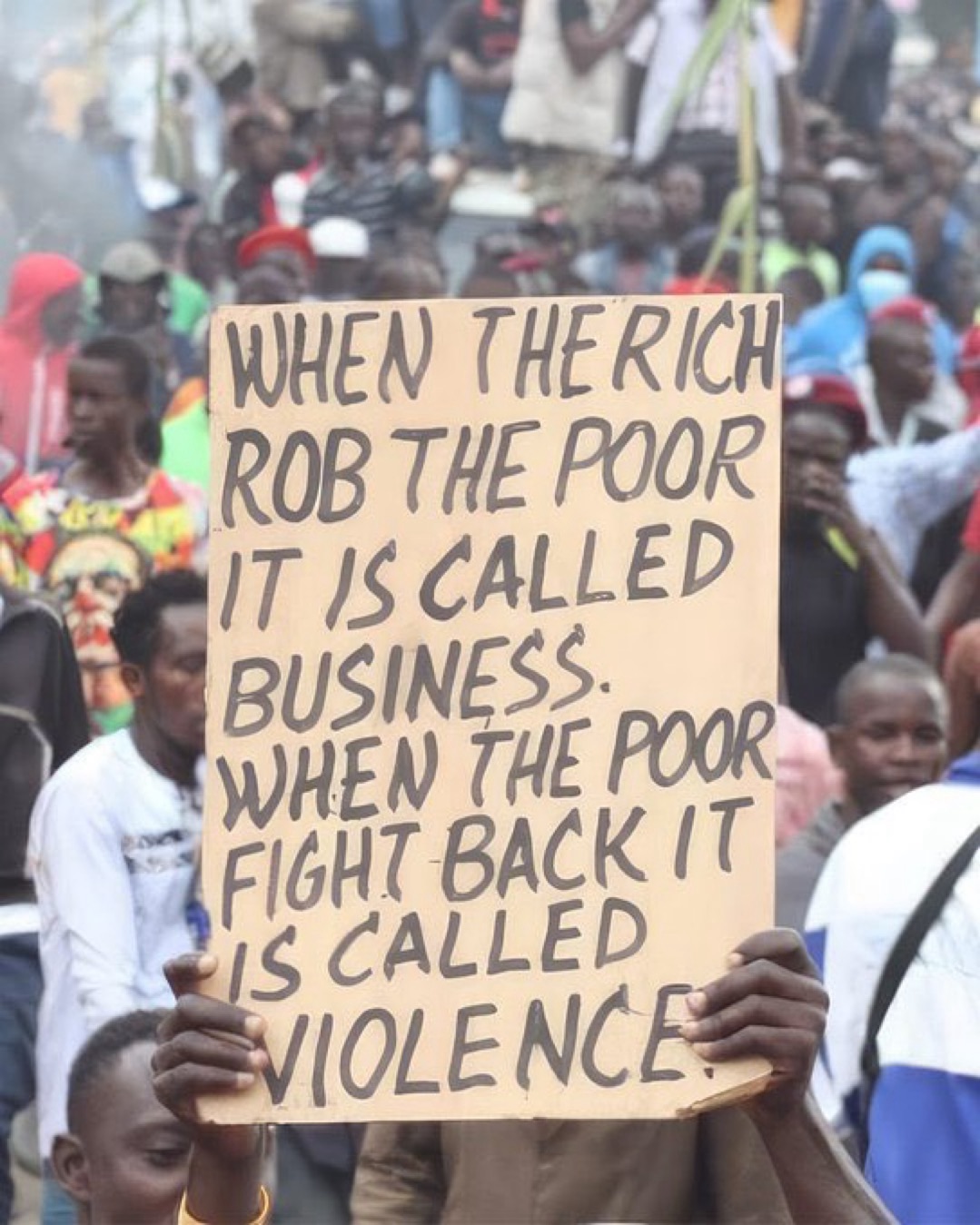
When the rich rob the poor, they call it business.
When the poor fight back, they call it violence.
The least we can do is call it what it is.
Leave a Reply