

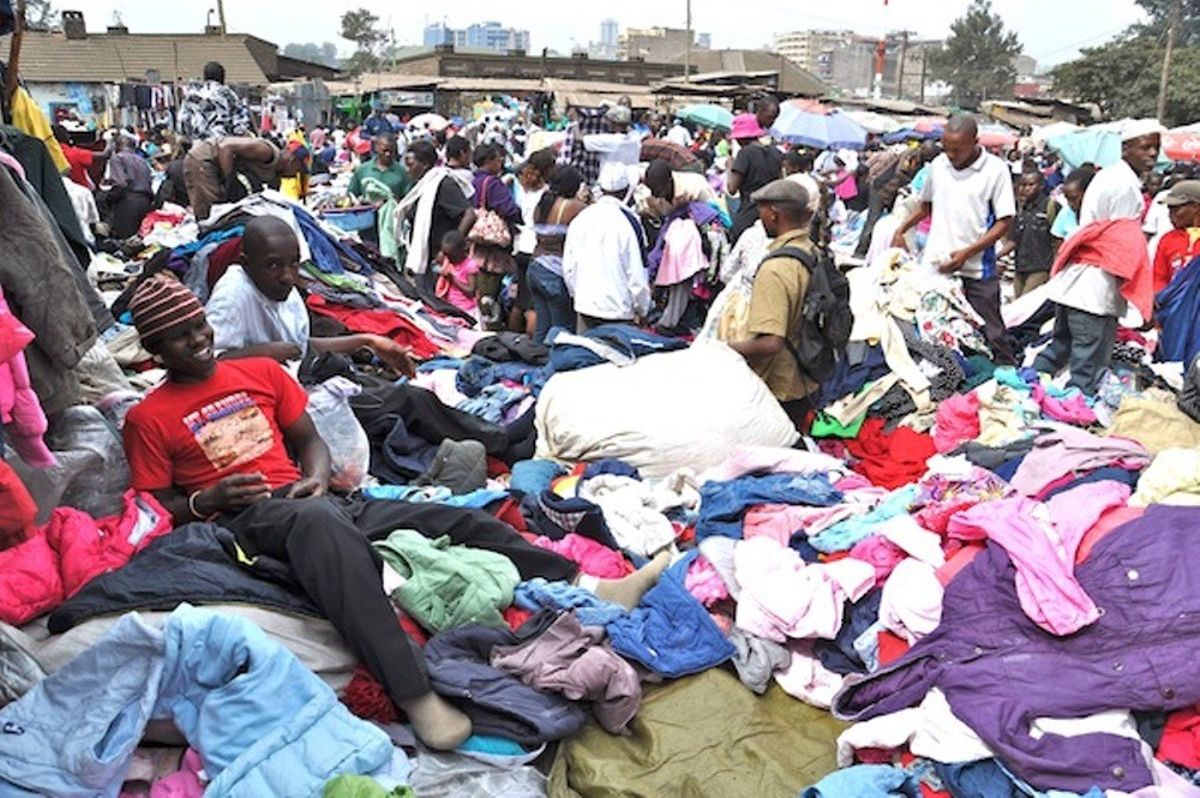
“Lukumi lukumi funa sikati wano. Lukumi lukumi sikati wano. Sister jangu o’laabe. Londa wano ku bei ya leero…” If you are not from Africa, you probably will not relate to the merchants’ cry at the market, the nudging of passersby to ‘take a look’ at one’s bulk of heaped garments displayed on makeshift shelves and plastic mats encroaching on the already stressed road, and the ensuing SharkTank-like bargain in which he ‘will make you an offer you can’t refuse’. I am talking about the booming trade in clothes seeking their second owner.
I once bought a green long-sleeved jumper conspicuously written on the words ‘Michigan State University’. I liked it a lot and wore it quite often but I wondered why those specific words were chosen. I mean this was such a random statement to put on a cloth. As years went by, it bothered me more and more that these companies kept putting such random statements on their shirts like ‘Welsh Hooker’, ‘Spring!’, ‘That’s a fact Jack’. Yes, I had a shirt written on welsh hooker. I too kept buying them because they were admittedly cheap options.I soon came to discover that these were in fact second-hand clothes. You can imagine the shock on an 8-year-old me’s face on realising the fact that someone can wear someone else’s used clothes. I just couldn’t believe the atrocities the human race was up to. Ofcourse, it didn’t take long for that to sink in but as I continued indulging in the second-hands, I wondered how I myself could make some quick bucks selling my used garments. And long story long, I bring to you this 5-minute read detailing why I failed to make some quick bucks, who is actually making the quick bucks and how it is affecting you.
So how does this industry work?
The second-hand clothing business started out largely as a charitable drive where people in the developed countries like the USA, UK, Canada, Australia and Germany donated old clothing through charity bins and similarly purposed drives. The organisations running these charity bins would then sort them and ship to the desired locations which were more often than not developing countries around the globe. Several decades down the road and it is a multi-billion dollar business worth approximately 100 billion dollars. The share of the second hand industry in the fashion industry is expected to increase tenfold from 3.5% by the end of the decade, being driven by the upsurge in ‘fast fashion’. Millions of garments are shipped to Africa weekly in sealed 50 kilogram bales carrying within them great mystery. Yes, essentially buying these bales is like placing a bet. You either have bought the deal of your lifetime that could be worth thousands, or you could have bought garbage worth thousands of zeros. As you would expect, many times it is absolute rags because most of the garments are fast fashion which is not designed to last. Only an unfair percentage of what arrives can actually be resold.


Undoubtedly, as times change, several aspects of our society change with it and the fashion industry is no exception. As it evolves, the African continent is flooded with numerous garment types from the Western world. This could potentially be a benefit by dispersing fashion trends and promoting cross cultural dressing across the globe in the spirit of cosmopolitanism. In addition, so many Africans benefit directly from the trade as retailers, importers and middlemen. The environmental effects of industrialisation could also potentially be mitigated since more used clothing recycled means less used clothing in the soil at a given time and less carbon emissions due to production of new clothing.
However, the flip side is a burgeoning trash crisis in many parts of Africa. A scarcity of means and outcomes has greatly limited the options of many Africans whose only option is the reused garments. This has earmarked the African continent as a big-buck market for the reused clothes and thus the mammoth influx of imported used clothing. In such societies characterised by this analysis, very few individuals can afford newly manufactured clothes imported or locally manufactured hence relatively few merchants opt to purchase new clothing lines. This prompts several business owners to import second hand clothing, usually characterised by low prices and abysmally low quality garments due to the time spent in use by previous owners.
The markets are flooded with these breeds of clothing and a significant amount of local markets have evolved to only indulge in these variants. Owino market located in Kampala, Uganda is famously known for the huge second-hand cloth deposits available. In response, the people as well opt to purchase these particular items due to the relatively cheaper costs. Other enterprising folks opt to rebrand second hand clothes as first hand by refurbishing and repackaging them, hence putting them up for sale at the price of first hand clothing. This is done by merchants that commit to incur extra costs in rebranding. This is not as common. Ultimately, this business thrives in the global south.
What are the key drivers of this trade?
Fast fashion
Fast fashion is the term used to describe clothing designs that move quickly from the catwalk to stores to take advantage of trends. The collections are often based on styles presented at Fashion Week runway shows or worn by celebrities. In this era of the internet, the spread of information is by milliseconds and the consequence has been much greater engagement with social media and creation of internet influencers who influence trends. The keyword here is trends which means that these garments usually have short-lived lifecycles and are used by season. The consequence is overproduction.
Consumerism
Consumerism is the tendency of people living in a typically capitalist economy to engage in a lifestyle of excessive materialism that revolves around reflexive, wasteful and conspicuous overconsumption. Especially in the West, very many people use garments very few times before growing detached from them. The result is high demand and thus high production.

Waste management agenda
The above factors culminate in a large excess of garments that need some way to be disposed of, hence the birth of this all but creative idea of integrating waste into the bales of clothing to be exported. The West has forcibly integrated Ghana and many other African countries into their waste management systems which are only necessitated by consumerism and fast fashion.
The Trash Crisis: A Case study of Kantamanto Market in Accra, Ghana
Each week, Ghana receives over 15 million pieces of ‘Obroni Wa Wu’ from the West. ‘Obroni Wa Wu’ is a term used by Ghanaians to refer to these imported second hand clothes, meaning ‘dead white man’s clothes’. While the majority of these garments are donated with good intentions, 40% are still discarded due to poor quality and end up at landfills and in water bodies. The Kantamanto Market in Ghana’s capital, Accra, is West Africa’s epicentre for used clothing from the West. Here, traders sort through imported bales to try and secure a good deal but often, disillusionment ensues due to the heavy presence of fast fashion items, resulting in the inability of a big number to be resold in the local market thus becoming environmental hazards in Ghana and beyond.
Environmental activists have warned about the potential implications this might have as groups like the Ghana Water and Sanitation Journalists Network (GWJN) are raising awareness about this issue that is criminally underreported.
When rain falls and erosion happens, a lot of these secondhand clothing wastes are carried into the water bodies. Many of these items contain toxic dyes which could harm those who depend on the water bodies for domestic use. Also, most of the clothes are of non-biodegradable synthetic fabric that end up choking marine life. Take a look at the effects.


Does it solve the recycling problem?
No. The export of second hand clothes does not recycle anything but only delays disposal, disposal which is conveniently delayed so as to occur in foreign territory.. It is clearly seen that over 40% of the shipments to Ghana are disposed of on arriving. Furthermore, Ghana and many other nations do not possess the industrial capacity to process fabric from used garments that can be reused in the textile industry. This is definitely creating a false illusion of waste management. The real issues that must be tackled are consumerism, fast fashion and scaling the industry of recycling of textile fabric.
To ban or not to?
A broader understanding of the situation in Africa arouses internal conflict on the use of second hand clothes. Due to the low income status of many, individuals should not be criticised for purchasing or owning second hand clothes but rather encouraged to live within their means. This business is likely to continue to thrive for the foreseeable future in Africa due to the existent socio-economic constraints. The second hand clothing business is one of eminent potential. It provides affordable, fairly decent clothing for many classes of people and is also a source of livelihood for very many in Africa. While we realise that economic benefits of this trade do exist for certain groups of people, it is imperative to summon clarity in the weighing of the pros and cons. Without exercising quality control in this business, this is but transforming African cities into dumping grounds for textile waste from the global North. It is important for Africans to live dignified lives and this means that if this business is to continue, irreparable fabric and rags must be filtered out at sorting sites. African nations should also empower their textile industries to be able to recycle textile fabric so as to create decent clothing for their people. Africans should also empower their own textile industries by buying locally. This last point, I believe, is one of urgency as Africans should take their future into their own hands by learning to be patrons of their local industry and break biases against homemade products while the industries also strive to improve the quality of their supply.
Buy African, Build Africa!
Meet the co-author!

Janice Nkajja, 17 is a brilliant young mind, proud muganda and seasoned debater. She is heavily burdened by the issues of today and feels this burden has been placed on her shoulders. Fortunately, she possesses a pen. She loves to write and through her art you will see through the looking glass of the reality this world holds.


Leave a Reply