

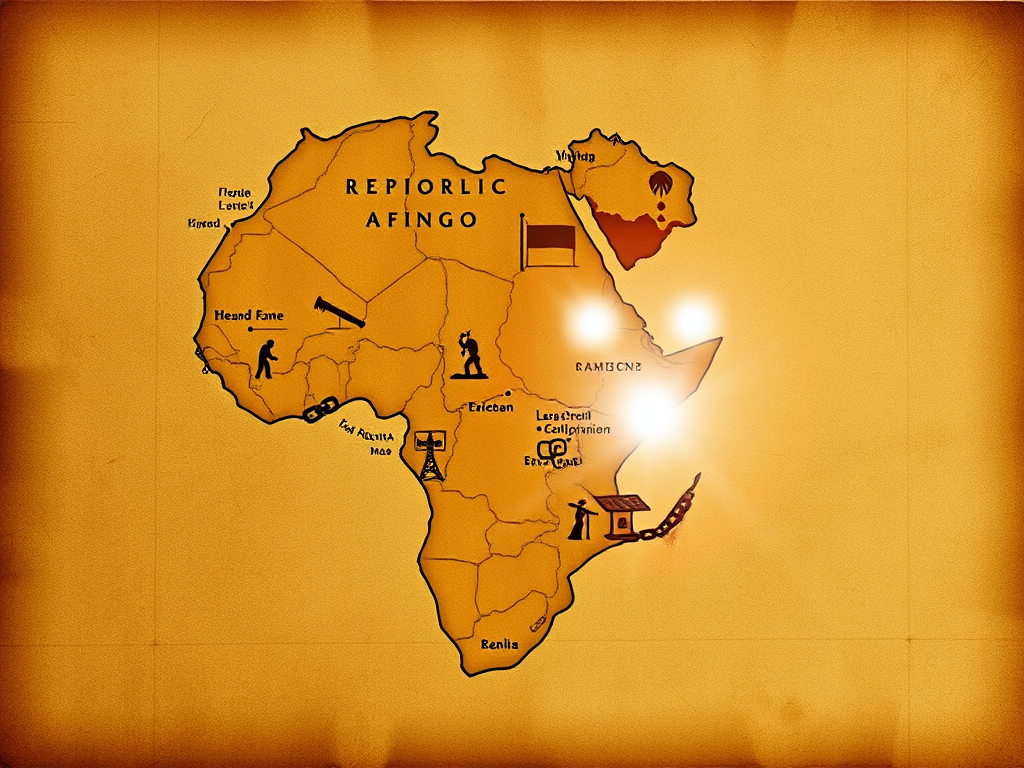
The Central African nation of the Democratic Republic of the (DRC) has been plagued by conflict for centuries, leaving behind centuries’ worth of scars. The history of the Democratic Republic of the Congo is replete with tragedies that have permanently altered the people and the land, from colonial exploitation to post-independence conflict. Through a historical perspective, an analysis of the DRC’s economic condition, an examination of the reasons behind the ongoing conflict, and a focus on the complicity of both internal and external actors, my aim in this article is to examine the current situation in the country

A Historical Background of Division and Exploitation
We must first examine the nation’s colonial past in order to comprehend the origins of the current conflict. In the late 19th century, King Leopold II of Belgium claimed the Congo as his own, making it a well-known personal colony. He oversaw one of the most cruel and exploitative governments in contemporary history, which affected the Congolese people. Millions of people died as a result of the king’s unquenchable avarice, which compelled them to work as slaves to harvest ivory and rubber from the soil. The exploitation persisted even after the Belgian government seized power in the Congo in 1908, albeit with a somewhat less ruthless façade.
The DRC gained full independence in 1960, but not without repercussions. Internal strife was stoked by the country’s severe ethnic and regional differences as well as the withdrawal of Belgian colonial forces. A few weeks after independence, the mineral-rich province of Katanga, led by Moïse Tshombe, attempted to secede, causing the first significant crisis. The UN’s subsequent action to put an end to this secessionist movement exposed the new Congolese state’s vulnerability.
However, colonial mismanagement is not the only factor contributing to the current crisis. The seeds for future instability were planted by the legacy of ethnic differences, the absence of economic diversification, and the inadequacy of state institutions. Coupled with its numerous ethnic groups frequently prioritized local or regional allegiances, the DRC struggled for decades to forge a unified national identity.
In 1994, 800,000 people were slaughtered during the genocide in Rwanda. The genocide was carried out by Hutu-led pro-government militia who targeted members of the Tutsi minority community and anyone who tried to protect them. A Tutsi-led rebellion ended 100 days of massacres by marching on Rwanda’s capital Kigali and pushing millions of Rwandans, including the militia and security forces that committed the genocide to cross the border and seek refuge in DRC, then called Zaire. Soon after, the new Tutsi-led government in Kigali joined forces with the armies of Uganda and Burundi, as well as Congolese armed groups, to invade the DRC and overthrow the Mobutu government.
The wars that followed are known as the First and Second Congo Wars (1996-1997 and 1998-2002). Some of the ongoing major armed conflicts in eastern DRC are a continuation of these wars. Numerous armed groups, arose out of this turmoil. Each of them with constantly evolving alliances and rivalries with the various political powers and state authorities party to the conflict. These interwoven conflicts were marked by a swath of crimes under international law and other human rights violations, including mass killings, enforced disappearances, rapes and other sexual violence, and torture.
The Economic Strain: A Nation Rich in Resources but Poor in Development
On the other hand, the DRC despite having numerous natural resources, such as diamonds, gold, cobalt, copper, and coltan—all essential minerals in the contemporary world economy—are found in this nation it is still among the poorest in the world. Nevertheless, despite the vast wealth that lies beneath the surface. This isn’t just an accident. A major problem in the conflict has been the exploitation of Congolese resources by both foreign powers and local elites.
Despite having abundant natural resources, the DRC’s economy is beset by corruption, a bloated public sector, a lack of infrastructure, and a reliance on mining. Wealth is frequently taken out of the nation by corrupt elites and foreign corporations who are more concerned with short-term gains than the long-term prosperity of the nation. Because armed organizations frequently battle for control of lucrative mining locations, this economic exploitation has exacerbated the war. These organizations can function comparatively unhindered because of the absence of efficient governance and the pervasiveness of corruption.

The Conflict Today: A Country in Perpetual Crisis
The DRC’s ongoing conflict is not a recent development. It has its roots in the First and Second Congo Wars (1996–1997 and 1998–2003), in which militias and many neighbouring nations fought for control of the nation’s mineral resources. Although a tenuous peace deal resulted from the Second Congo War’s formal end in 2003, the conflict’s underlying causes—ethnic conflicts, poor administration, and the competition for resources—have never been adequately addressed.
Numerous armed organisations, including the M23rebels, the Allied Democratic Forces (ADF), and other Mai-Mai militias, are still engaged in combat in the eastern provinces of North and South Kivu, Ituri, and portions of Katanga. These organisations are driven by a mix of ethnic rivalries, the ambition to impose their own form of government, and control over lucrative minerals.
The struggle for control of mining areas is one of the main causes of the war. Armed factions often vie for control of valuable mineral resources, such as tin and coltan, which are vital for the manufacture of electronics. Local residents are now trapped in the crossfire as a result, and their ability to make a living depends on these militias’ presence. One of the main causes of the violence has been the participation of international firms, many of which have questionable ties to these armed organizations. Violence has been fuelled by the global desire for electronics, particularly laptops and cellphones, which has led to the creation of a market for conflict minerals.
The Human Cost: A Tragedy of Untold Proportions
The violence has had a catastrophic toll. Millions of people have died in the DRC over the last 20 years, either directly as a result of conflict or indirectly as a result of illness and starvation. Over 5 million people have been displaced by the conflict, making it one of the world’s worst refugee crises. Widespread violations of human rights have also resulted from the scenario, such as forced child military recruitment, mass rape, and the devastation of entire communities. While the world often ignores their suffering, the people of the Democratic Republic of the Congo continue to suffer the most from this bloodshed.
Social services have also been impacted by the conflict, especially in the fields of education and health. In the impacted communities, schools and hospitals are frequently demolished or abandoned, depriving entire generations of access. The cycle of poverty and conflict is sustained by this lack of access to basic amenities, making the nation’s reconstruction all but impossible.
Who is Complicit? The Internal and External Actors
In addition to domestic issues, external players have contributed significantly to the escalation of the violence in the Democratic Republic of the Congo. The exploitation of the nation’s resources is carried out with the cooperation of numerous foreign governments and multinational corporations, whose activities fuel the ongoing instability.
The conflict has engaged the neighbouring nations of Rwanda, Burundi, and Uganda, either directly interfering in the internal affairs of the Democratic Republic of the Congo or providing support to rebel organisations. Though the Rwandan government disputes these claims, Rwanda in particular has been charged with supporting the M23 rebels in the Kivu region. The historical friction over the existence of Hutu militias in the DRC, who escaped Rwanda following the 1994 genocide, and the desire to control resources are the main drivers of these nations’ involvement.
Multinational firms have also been charged with escalating the war by sourcing materials from conflict areas, especially in the mining industry. These businesses frequently ignore the violations of human rights that take place in these regions, prioritizing financial gain over morality. A market for minerals that support armed organizations and prolong the agony of the Congolese people has been created by the worldwide desire for cellphones, laptops, and other technological equipment.
Recent developments in the conflict
In early 2025, fighting between Congolese security forces and militant groups led by M23 escalated rapidly, culminating in M23’s capture of Goma, the regional hub of the Eastern Democratic Republic of Congo (DRC; the Congo) on the Rwandan border. Rwanda, the primary backer of the M23 armed group, supported its offensive in eastern DRC with three to four thousand ground troops. As Goma fell, thousands of locals—many of whom were already internally displaced—fled the region. On February 4, M23 declared a unilateral ceasefire. Between 900 people, by UN estimates, and 2,000 people, by Congolese government estimates, were killed in the offensive on Goma. M23 is the latest in a series of Rwanda-backed militant groups that have been vying for territory and valuable natural resources in the eastern Congo since the late 1990s. The escalation in Goma exacerbated nationwide political violence—including in the capital, Kinshasa—which surged following DRC’s December 2023 national elections. With one million Congolese seeking refuge abroad and twenty-one million people in the country in need of urgent medical, food, and other aid, the DRC represents one of the largest and deadliest humanitarian crises in the world.
With historical, economic, and geopolitical facets, the ongoing conflict in the Democratic Republic of the Congo is a complicated and deeply ingrained problem. Even while the DRC’s citizens have persevered in the face of unspeakable adversity, more has to be done by the international community to address the conflict’s underlying causes. This entails making sure that foreign firms accept accountability for their part in escalating the violence in addition to holding dishonest Congolese elites accountable. More significantly, establishing a long-lasting peace that meets the demands of the populace, restores their dignity, and enables them to rebuild their country calls for a team effort.
The turmoil that still afflicts the DRC and its history do not define its future. However, the way forward necessitates recognizing the part played by both internal and external players and cooperating to build a prosperous and peaceful future for the Congolese people. Now is the moment to take action since waiting would only make the agony of those who have already gone through too much worse.
Leave a Reply