
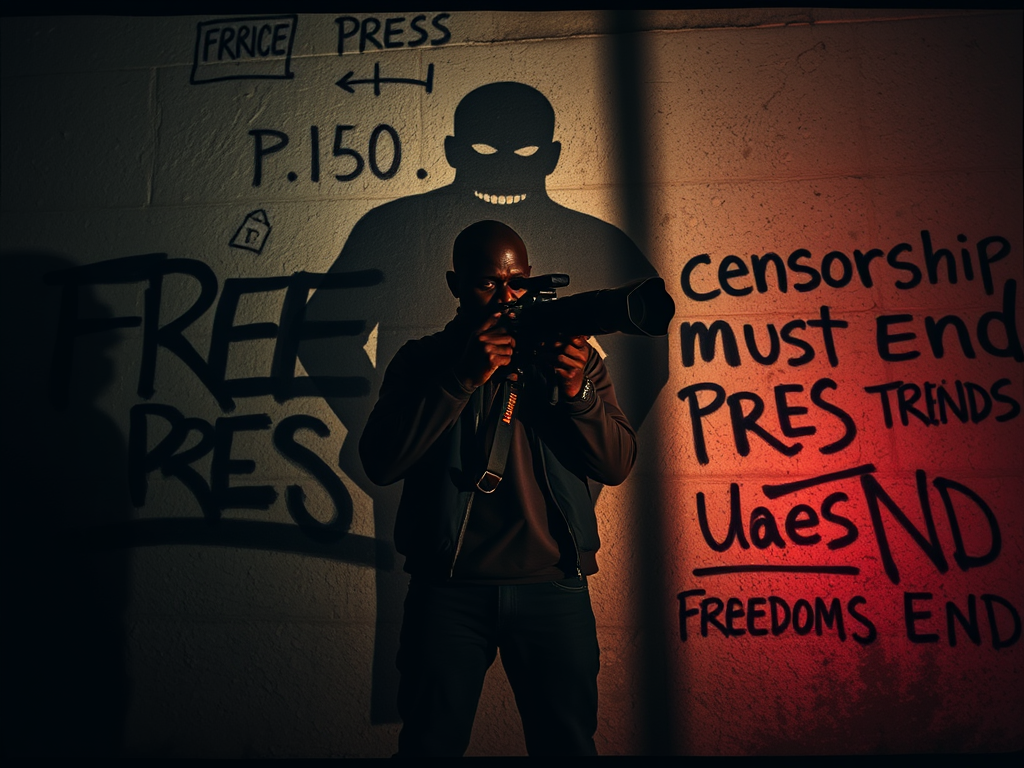
Press freedom in Africa is under attack. Journalists, activists, and even ordinary citizens are being muzzled by censorship, brutality, and intimidation. The very right to free expression, the pillar of democracy, is being undermined before our eyes. The question we need to ask ourselves is: How safe is free speech in Africa today? Spoiler alert—it’s not safe at all.
The Reality of Press Freedom in Africa

Following the Reporters Without Borders 2023 World Press Freedom Index, most African nations are either “difficult” or have “very serious” press freedom conditions. They are placed on this basis because of increasing state repression, online surveillance, and ill treatment of journalists. Top offenders among them are Eritrea, Sudan, Egypt, Rwanda, and Ethiopia, where journalists are often intimidated, imprisoned, or even murdered for reporting.
Yet, this is no longer just about a few oppressive regimes. In so-called democracies, including Uganda, Kenya, Nigeria, and Ghana, journalists face increased restrictions, imprisonments, and harassment for disclosing government failures, corruption, and human rights violations.
Governments in Africa have perfected the art of censorship through a combination of legal, online, and physical restrictions to manage the flow of information. Internet shutdowns are one of the most worrying trends. In 2023 alone, Africa saw more than 15 internet shutdowns in several countries, with Sudan, Ethiopia, and Zimbabwe being the worst perpetrators. Access Now has reported that these shutdowns normally occur during periods of election, protests, or political tension in an attempt to prevent citizens from mobilizing or gaining access to independent media.
Uganda is a case in point. During the 2021 general elections, the government completely switched off the internet for five days, restricting access to social media and online news platforms. President Yoweri Museveni defended the move as a way of preventing “external interference,” but we all know what the real reason was—it was to silence opposition and control the narrative of the elections. The shutdown was massive, affecting businesses, media agencies, and even emergency services that relied on digital communication.
Banning and prohibition of media outlets is another type of censorship. In Ethiopia, independent media outlets, particularly those reporting on the Tigray conflict, have been shut down by the government. In Nigeria, the government has banned critical online media and newspapers several times. In 2021, Twitter was suspended in Nigeria after Twitter deleted a tweet by President Muhammadu Buhari that contained threats against separatist movements. These actions set a negative precedent where governments believe that they can decide what information should be made public.
And when censorship fails, the authorities move to brute force. African journalists are in severe danger of bodily harm, imprisonment, and outright assassination for the simple act of doing their job.
Take the case of Uganda’s Kawempe bye-election in 2024 for instance. Journalists who attempted to cover opposition campaigns were assaulted, arrested, and had their equipment confiscated. It was not an isolated event. In the 2021 Ugandan election, some journalists were brutally beaten up by security officers while they covered election malpractices.
I still remember the violent attack on Ghetto TV journalist Ashraf Kasirye. He was covering opposition leader Bobi Wine’s campaign when he was shot on the head by security agents. Though he survived, the message was clear: covering the opposition is a fatal business.
This is not a Ugandan phenomenon. In Sudan, security forces killed at least two journalists covering the 2021 pro-democracy protests. In Mozambique, investigative reporter Ibraimo Mbaruco disappeared in 2020 after repeatedly reporting government corruption—no trace of him was ever found. Reporters Without Borders indicates that Africa is now, and still remains, one of the most hazardous continents on which to be a journalist, and over 100 reporters were killed in the past ten years for their reporting.

Intimidation: Fear as a Tool of Control
When journalists and activists are not intimidated by violence or censorship, intimidation is the fallback. African states deploy false charges under law, defamation suits, and computer crime laws to keep journalists in line.
An example is Hopewell Chin’ono, a Zimbabwean journalist who was arrested multiple times in 2020 and 2021 for covering corruption in the government’s COVID-19 procurement deals. His crime? Revealing that public funds meant for medical supplies were being siphoned off by government officials. He was jailed for over 40 days and continues to be harassed by the state.
Nigeria has also used the cybercrime laws to arrest its critics. At least 20 activists and journalists were arrested in 2022 alone for posting critical tweets against the government. One such person was Agba Jalingo, who spent 179 days in jail in 2019 for having published an article pointing to financial misgivings in the Cross River State government.
More alarming is the effect of press intimidation on regular citizens. In Tanzania, individuals have been arrested for nothing more than critical WhatsApp messages. In Rwanda, YouTubers and bloggers have disappeared for covering opposition politics. The message is unmistakable: criticize the government, and you will be punished.
Others can say, “Why should I care? I’m not a journalist.” But the fact is, if the media are not free, then none of us are free. A controlled media landscape is one where we’re given propaganda instead of fact, allowing governments to cover up corruption, human rights abuses, and election theft. It also silences youth activism—when alternative media are stifled, social movements lose their voice and visibility. Worse still, censorship emboldens dictatorships, which allow autocrats to spin the story, silence critics, and tighten the grip on power. We’ve seen this play out across Africa, from worst-ranked on the World Press Freedom Index Eritrea, where independent reporting has been all but absent for two decades, to Cameroon and the Democratic Republic of Congo, where critical authors are either forced into exile or held indefinitely.
Why does having this conversation matter?
Freedom of speech and an independent press are the lifeblood of any democratic nation and the essential pillars for responsibility, transparency, and public participation. With political unrest, corruption, and lack of respect for human rights still being burning issues facing most African nations, making sure that such freedoms are in place is more of a priority now than ever before. A free press galvanizes citizens by providing them with credible information, enabling them to make authoritative decisions on governance and social issues. It serves as a watchdog, reminding governments and institutions to be responsible for their actions. In its absence, corruption is rampant, as seen in countries where journalists are intimidated, imprisoned, or assassinated for uncovering the truth. Countries with restricted press freedom have more instances of government abuses, economic stagnation, and human rights abuses.
Besides, freedom of expression fosters public debate, allowing citizens to express their grievances, advocate for reforms, and engage in constructive debate on the fate of their nations. Societies that deny free expression instill fear and silence opposition, leading to oppression and instability. When citizens are not allowed to protest peacefully, they are likely to protest and, in extreme cases, civil strife.
Technology and cyberspace have provided new avenues of expression, but they are also the arenas in which governments exercise censorship and observation. Africa must shun this temptation towards digital authoritarianism and instead incorporate policies favoring press freedom and free expression as fundamental human rights.
In order for Africa to truly progress, economically develop, and achieve social justice, these freedoms must be protected. A country in which people are free to think, speak, and question what they wish is a country that fosters innovation, democracy, and stability over the long term. The future of the continent depends on this.
What Can We Do?
We are not helpless. Young people throughout Africa have the resources to resist press censorship and uphold free speech. This is how we can act:
Support independent media – Mainstream media in the majority of African countries is state-controlled, but independent journalism websites continue to fight for the truth. Following, subscribing, and donating to websites like The Continent, African Arguments, and The Elephant helps sustain fearless reporting that is not state-controlled. Use social media as a tool for truth – The governments are afraid of the power of going-viral stories, so we must use platforms like TikTok, Twitter, and Instagram in order to amplify muffled voices and expose abuse. But judicious use is of the highest priority—double-checking sources beforehand prevents the spread of false information, which is going to be abused to prolong media restrictions.
Hold leaders accountable – Press freedom should be a strict requirement when voting for leaders. Young voters should insist on policies that protect journalists, demand transparency from the powerful, and criticize governments who silence free speech.
Stand in solidarity with activists and journalists – When activists are gagged or journalists arrested, our voices matter. Signing petitions, taking part in demonstrations, and calling for their release sends a strong message that censorship will not be tolerated. Every action, no matter how small, matters in the grand fight for media freedom in Africa.
Africa’s youth must wake up to the reality that in the absence of press freedom, democracy is an illusion. We cannot build a just society if the truth is censored, dictated, and withheld from us. The time is now. We are the generation that must stand up for free speech because if we do not, nobody will.
The question remains: Will we fight for our voices, or will fear mute us?
Let’s speak up. Let’s demand change. Let’s not be silenced.
Leave a Reply