

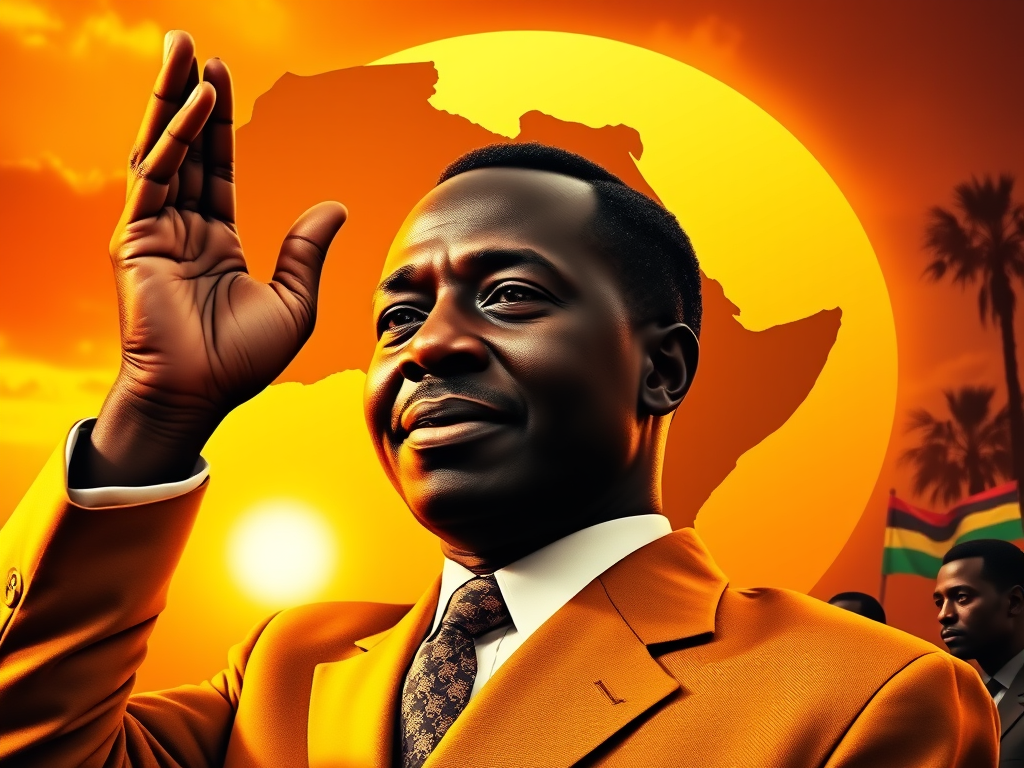
At the heart of the 20th century, amid a wave of independence struggles, the dream of a single African nation—the United States of Africa—excited the imagination of Pan-Africanists and radicals. It was not merely an issue of spatial integration; it was a revolutionary appeal for dignity, sovereignty, and independence for a continent once divided by colonial borders and imperial ambitions. But today that vision seems to flash in the rearview mirror of the ages. Was it only an impossible ideal, or is there a template for getting it started again?
This essay explores the origins of the United States of Africa concept, its causes of failure, its contemporary expressions as Pan-Africanism, and whether it is possible to witness a renaissance of unity in the 21st century.
The idea of a United States of Africa was envisioned by the early Pan-Africanist thinkers like W.E.B. Du Bois and Marcus Garvey. Garvey particularly gave an environment of Black pride and solidarity to his “Back to Africa” movement with his vision of a colonial-free and united-in-purposes Africa. His vision was not just the repatriation of Africans to their continent but the establishment of an African empire that would be a world center of Black excellence and power. Garvey’s Universal Negro Improvement Association (UNIA) was the largest Black organization in the 20th century and established the cultural and ideological basis for the Pan-African unity movement.

It was Kwame Nkrumah, the president of Ghana and one of the great revolutionary leaders in Africa, who gave institutional and ideological depth to the notion. It was Nkrumah’s firm conviction that politically integrated Africa alone could resist neo-colonial exploitation and achieve true economic independence. His Pan-Africanism was not so much philosophical but also pragmatic. He considered fragmentation as a primary tool of imperial rule and feared that the newly liberated African states would remain economically dependent and politically manipulated unless they merged.
Nkrumah was a key figure in the founding of the Organization of African Unity (OAU), the precursor to today’s African Union (AU), in 1963 and declared: “Africa must unite. We have the resources. We have the manpower. Can we not make it work for the benefit of our people?” This was not rhetoric. Nkrumah was a believer in continental government, a single currency, a merged military, and one foreign policy. He even recommended the creation of an African central bank and continental parliament. These were outlined in his 1963 book, “Africa Must Unite,” and he believed that unity was not only something to be wished for but essential if Africa were to be in a position to prevent underdevelopment and exploitation.
Despite resistance, Nkrumah’s charisma and belief made him a leader of the Pan-African movement. He hosted numerous conferences in Ghana to bring African leaders and diaspora intellectuals together, and he advocated for the liberation movements on the continent. His vision of unity was revolutionary in his time and perhaps even now, but it set intellectual and moral precedent for the idea of African continental integration.
The dream of a United States of Africa, though deeply inspiring and founded on a vision of pan-African solidarity, was ultimately faced with a complex matrix of challenges that kept it from being achieved. Perhaps the most persistent challenge was the colonial history, particularly the random boundaries drawn at the 1884–85 Berlin Conference. These boundaries carved up the continent into over fifty distinct countries, each with their own languages, cultures, and colonial histories. This fragmentation gave rise to a sense of national identity that often overshadowed the overall objective of continental unity. Moreover, with the onset of the Cold War era, Africa became an international superpower front. The majority of African countries found themselves aligning themselves with either the United States or the Soviet Union, not due to ideological similarity but in most instances in seeking assistance or military aid. These alignments consolidated domestic divisions and fostered competing interests among African states, diluting integration initiatives.

Economic disparities also presented significant barriers. The unbalanced development of the continent implied that wealthier nations naturally did not wish to inherit the economic burden of poorer states, making the idea of economic integration politically and pragmatically difficult. Moreover, variations among Africa’s founding leaders further disintegrated the movement for unity. Whereas Kwame Nkrumah envisioned a federal, centralized state for Africa, there were others, such as Tanzania’s Julius Nyerere, who favored a more conservative, incremental style of cooperation. This ideological cleavage was perhaps best encapsulated in the contrast between the Casablanca Bloc, which favored immediate political unity, and the Monrovia Bloc, which preferred national sovereignty and incremental integration. The compromise that followed was state sovereignty-dominated, undermining the original vision for a united Africa.
Finally, the institutional framework that was supposed to drive unity, in particular the Organization of African Unity (OAU), struggled to promote meaningful cohesion. Often criticized for its policy of non-interference, the OAU lacked the enforcement machinery and political will to force member states to conform to the rules or drive meaningful integration. Its reputation as a “club of dictators” highlighted its limitations, as it was more of a diplomatic courtesy than a revolutionary political force. In general, the United States of Africa fantasy did not fail because there was insufficient vision or passion, but due to a convergence of historical, political, economic, and institutional difficulties that made unity an unobtainable ideal.
In today’s Africa, the vision of a United States of Africa continues to reverberate through many political, economic, and cultural landmarks. The establishment of the African Union (AU) in 2002 represented a significant move away from the limitation of its inheritance, the Organization of African Unity. Through initiatives like Agenda 2063, the AU contains a vision for a politically unified and economically integrated continent. Institutions such as the Peace and Security Council and the ongoing efforts towards ending conflicts are demonstrations of incremental yet meaningful steps towards these ambitions. Economically, the launch of the African Continental Free Trade Area (AfCFTA) in 2021 is arguably the most ambitious endeavor at fostering economic interdependence across the continent. By removing obstacles to trade and increasing intra-African trade, AfCFTA offers ground-floor work towards increased political integration. At the cultural level, there is a Pan-African renaissance evident through manifestations such as “Afrobeats to the World,” renewed claims to heritage on the part of the African diaspora, and dynamic digital activism by young people. Greater continental identity is also supported by regional blocs of ECOWAS, EAC, and SADC, which have made real strides in regional economic and political integration. While such blocs do not represent full continental unity, they represent a pragmatic, regionalized effort to realize Pan-African objectives.
Resuscitating the vision of a United States of Africa, while clearly challenging, is still attainable if pursued via strategic and participatory methods. Central to such a vision are the continent’s youth, who make up over 60% of Africa’s population and constitute a formidable movement for transformation. By investing in civic education, entrepreneurship, and technology literacy, young people can be empowered to create a new Pan-African identity rooted in solidarity and common purpose. Education is also essential to this endeavor. By integrating African history, values, and philosophies into school curricula, the continent can begin to overcome the lingering colonial mindsets. Furthermore, promoting lingua francas like Kiswahili or embracing African multilingualism can help to fill linguistic gaps and improve cross-cultural communication.
Accountability and good governance are also central pillars to unity. Democratic values for all, open institutions, and human rights respect must be the foundation of any integration process. Institutions such as the African Court on Human and Peoples’ Rights require increased recognition and legitimization to make accountability and justice more than concepts, but actual practices. At a practical level, continental integration also relies on the integration of common infrastructure. A coordinated strategy of transportation networks, digital connectivity, and energy systems would not only consolidate economic interdependence, but also enable cross-border cooperation. Pan-African investment in science, technology, and innovation is also critical to fueling sustainable development and global competitiveness.
Finally, transformational leadership and recasting Pan-African diplomacy are essential. Africa needs leaders who place the greater good over personal, nationalist agendas. Diplomatic efforts—regionally in Africa and globally—must be refocused on collective bargaining leverage and mutual benefit. In the final analysis, even though the issues are real, a unified Africa is a dream that can be rekindled with visionary audacity, human-centered policies, and shared commitment to continental progress.
The vision of the United States of Africa was deferred, not defeated. It lingers in the aspirations of the next generation, in the shared rhythms of African music, in the AU policies, and in the hearts of those who can imagine a unified, respected, and self-defined Africa.
To move from fantasy to reality, Africa must reconcile with its past, make the most of its potential, and rethink its future. A United States of Africa is no political formation—it is a vision of unity, autonomy, and sustainable development. Regardless of whether that vision comes in the form of a federation, an impenetrable union of states, or closely integrated bloc, the intent is the same: Africa’s future is unity, and that future remains within grasp.
Leave a Reply