

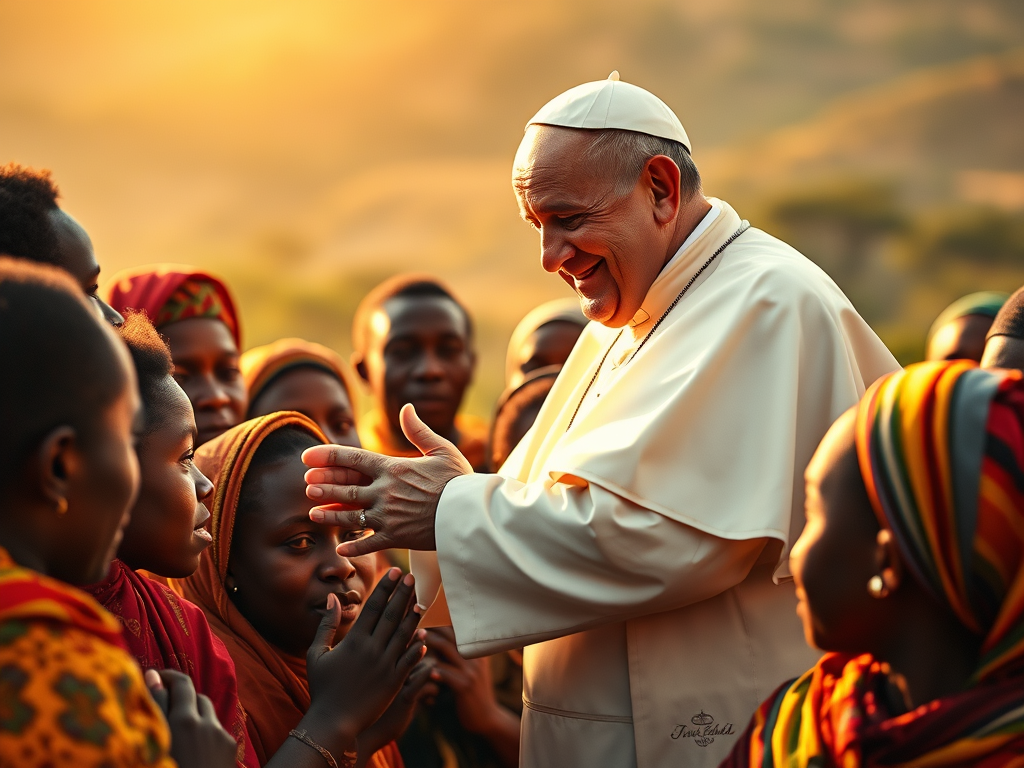
The world stood still in a rare instant of collective sorrow at the passing of Pope Francis, the 266th Bishop of Rome, a pope whose papacy was characterized by a radical simplicity, great humility, and unwavering commitment to justice. Born Jorge Mario Bergoglio in Buenos Aires, Argentina, in 1936, Francis was born of humble beginnings as the son of Italian immigrants to rise to become the first pope from the Global South and the first Jesuit to ever hold the papacy. His death was greater than the passing of an era; it was the death of a shepherd who redefined the parameters of religious leadership in the 21st century, and whose legacy extended far beyond the gold-encrusted corridors of the Vatican into the most distant reaches of the Global South—most particularly Africa, a continent he loved deeply and whose problems he encountered with a tough and compassionate heart.
Pope Francis’ legacy in Africa is not just in what he uttered or where he traveled, but in his deeper philosophical and theological stance on international inequality, climate justice, migration, and the dignity of the poor. Since the start of his papacy in 2013, Francis has articulated a theology that addressed directly the lived life of the majority of Africans—poverty, war, forced displacement, corruption, and structural injustice—and yet also by a richness of faith, cultural diversity, and spiritual resilience. In some ways, Francis addressed the continent not so much with moral sympathy but spiritual validity; he recognized the African Church not as a Catholic fringe but as a thriving, growing, and indispensable hub of the Christian world.

Throughout his papacy, Francis made three visits to Africa on grand pastoral visits—Kenya, Uganda, and the Central African Republic in 2015; Egypt in 2017; Morocco in 2019; Mozambique, Madagascar, and Mauritius in 2019; and South Sudan and the Democratic Republic of Congo in 2023. All of these visits were never ceremonial in nature. They were deliberate acts of spiritual diplomacy—efforts to amplify the voice of the voiceless, to call for peace in regions torn by ethnic and political conflict, and to encourage local churches that were often struggling under hopeless conditions. In Uganda, he remembered the Ugandan martyrs—Catholic and Anglican youth who were slain for their beliefs in the 19th century—emphasizing his faithfulness to ecumenism and reverence for African religious tradition. In the Central African Republic, he went to a war-stricken nation midst bloody violence, defying objections, opening the Holy Door of the Cathedral of Bangui to initiate the Jubilee Year of Mercy. That in itself—that action of one pope ignoring security advice to go into a war zone—spoke volumes about his theological prioritization of mercy, proximity, and peace over protocol and convenience.
Francis also stood as a prophetic voice in challenging the structures of global injustice that affect Africa disproportionately. His encyclicals Laudato Si’ (2015) and Fratelli Tutti (2020) did not address African issues as distant problems but as moral crises at the center of global spiritual failure. In Laudato Si’, Francis explicitly called out the exploitation of natural resources in the Global South by multinational corporations, speaking against a “throwaway culture” that treats entire peoples and ecosystems as disposable. This message struck a deep chord in African communities battling the environmental fallout from oil extraction in Nigeria, deforestation in the Congo Basin, and climate-induced displacement across the Sahel. To the majority of African theologians and green activists, Francis’ words gave theological legitimation and support of grassroots resistance to environmental colonialism.
His encyclical Fratelli Tutti, in which he emphasized fraternity, dialogue, and social friendship, again made Francis a spiritual friend of Africa’s peacemakers. The encyclical was full of the pope’s frustration at rising xenophobia, exclusion, and nationalism—a situation all too familiar for millions of African migrants who attempt to cross the Mediterranean or join European societies. Francis consistently denounced what he called the “globalization of indifference” and demanded a radical reimagining of borders, calling on nations to accept migrants with compassion. This was not just lofty rhetoric. In Lampedusa in 2013, early in his papacy, Francis took his first major papal visit to where thousands of African migrants had perished at sea, praying and calling out Europe’s immigration policy to account on moral grounds. His consistent commitment to the destiny of African refugees and his condemnation of Fortress Europe challenged the Catholic Church—and the world—to see African lives as not distant tragedies, but as part of our shared human dignity.
Pope Francis also exercised an indirect but significant impact on the African Church’s own political and theological debate. He promoted inculturation—the incorporation of African languages and traditions into the liturgy—and a church not only of and for the poor but of the poor. In nations like Zambia and Burkina Faso, Catholic faithful began to take more daring chances with contextual theology, following the example of Francis in challenging corruption, advocating justice, and in defending community assets. While others, especially those on the more right-wing branches of the Church, grumbled that Francis was diluting doctrine in return for social justice, the majority of African bishops read his message as reaffirmation of Catholic social doctrine in terms of the Gospel call to serve the least of us.

On gender too, though Francis never substantially altered Church doctrine, he took powerful symbolic gestures and opened up avenues of conversation. In several addresses to African audiences, he condemned violence against women, sex trafficking, and exclusion of women. He praised African women as pillars of the faith, addressing them as the “backbone” of the Church. While he failed to endorse ordination for women, his act to name them to Vatican leadership roles, and his frequent praise for their pastoral and intellectual activity, created an atmosphere of inclusiveness that responded to the realities on the continent, where women play important but often unheralded roles in the spiritual and social life of communities.
Most profoundly, perhaps, Pope Francis exhibited a leadership style that departed from the triumphalism of his predecessors and leaned toward African religious sensibilities. He lived in simple living arrangements, he drove a modest car, and he constantly used his own power to raise the voices of the marginalized. His theological emphasis on healing, encounter, and mercy found fertile ground in African societies where churches are the prime institutions for social services, education, and conflict mediation. Francis legitimized these roles not as secondary to Church mission but as central to the Gospel. He was wont to observe that pastors have to “smell like the sheep”—terms that resonated with African pastors working in demanding environments to shepherd displaced groups, poor villages, and fragile democracies.
Francis’ death has provoked universal reflection, but in Africa, the loss is most intimate. His papacy occurred at a critical moment in the continent’s religious and sociopolitical development. As Africa hurries to urbanize, grapples with demographic change, and battles the twin evils of secularization and extremism, the Church is a powerful moral force. With Francis, that energy was enabled to act not as some distant institutional force but as a “field hospital,” to borrow his phrase, tending the wounds of a wounded world. His papacy emboldened African Catholics to fulfill their prophetic calling—no longer simply to embrace the Gospel, but to evangelize it through acts of justice, reconciliation, and care of the earth.
The African future of the Catholic Church is bright and complex. With more than 250 million Catholics in Africa and some of the world’s most rapidly expanding dioceses, Africa is no longer a missionary frontier but a new center of theology. In the wake of Francis’ death, talk about the new pope has understandably centered on whether an African pope is possible. Men like Cardinal Peter Turkson of Ghana and Cardinal Fridolin Ambongo of the Democratic Republic of Congo are being eyed not only as symbolic candidates, but as experienced leaders who have a keen sense of the issues confronting the global Church. Their visibility on the global stage—partly because of Francis’ global and universal vision—has redefined what Catholic leadership could be like in an genuinely postcolonial Church.
Remembering Pope Francis, Africa remembers a pope, but also a pastor. A man who knelt to wash the feet of prison inmates, who braved his security to walk about refugee camps and war zones, who was daring to talk aboutuncomfortable truth about neocolonialism, racism, and exclusion. His own vision of Church as servant of the poor and witness to justice continues to energize a new generation of African theologians, activists, and lay leaders who are committed to constructing not merely a universal structured church but a local souled church.
While the bells toll in cathedrals from Kinshasa to Cape Town, Nairobi to Lagos, Africa is saying goodbye to a friend, a prophet, and a pope. But also, Africa is recalling a man who, with humility and boldness, showed us that the Gospel is weakest when preached apart from the poor, and the future of the Church is both as African as it is universal.
Leave a Reply