
Malaria is a disease that has haunted humanity for centuries—an unrelenting killer that spares neither the young nor the old. It thrives in the tropics, where warm, humid conditions create the perfect breeding ground for mosquitoes, especially in countries like Uganda. But there’s hope on the horizon. Uganda has recently joined the growing list of African nations introducing the malaria vaccine into routine immunisation—becoming the 19th country on the continent to do so. What’s even more exciting? This is the largest malaria vaccine rollout in Africa to date, both in terms of the number of districts covered and the population reached. It’s a big move—and a big moment—for public health in Africa.
Malaria by the Numbers
Malaria remains a global threat, with nearly half the world’s population living at risk across 85 countries. But Africa bears the heaviest burden. In 2023, the continent accounted for 94% of malaria cases (246 million) and 95% of deaths (569,000)—with children under five making up 76% of those lost. Countries like Nigeria, Ethiopia have seen massive spikes, recording atleast 1.3 million new cases each in 2022. These figures underscore just how urgently Africa needs lasting solutions—and why the rollout of the malaria vaccine is such a monumental step forward.
What is Malaria; really?
Malaria is an infectious disease caused by parasites from five Plasmodium species, with P. falciparum being the most dangerous. It’s mainly spread through bites from infected female Anopheles mosquitoes, though it can also be transmitted through blood transfusions or contaminated needles. Once in the body, the parasites first head to the liver, then move into red blood cells where they multiply and cause them to burst—triggering fever, chills, and body pain. If untreated, P. falciparum malaria can turn deadly within just 24 hours. Some parasites evolve into a more mature form that can be picked up by another mosquito, continuing the cycle of infection. This is how malaria spreads—and why prevention, early treatment, and now vaccination are so critical in the fight to stop it.
Malaria often starts with common symptoms like fever, headache, and chills—typically appearing 10 to 15 days after a bite from an infected mosquito. Since these signs can be mistaken for other illnesses, early testing is key.
While some cases are mild, malaria can quickly become life-threatening, especially for young children, pregnant women, people with HIV/AIDS, and travellers. Delayed treatment can lead to serious complications such as extreme fatigue, confusion, seizures, liver failure, jaundice, low blood sugar, kidney failure, lung complications, or even coma; individually which can cause death. In pregnancy, malaria can also cause premature birth or low birth weight.

Counting the Cost: Why Malaria Remains a Heavy Burden
Malaria isn’t just a health problem—it’s a heavy economic and social burden that affects both individuals and entire nations. For families, the cost of dealing with malaria quickly adds up. There are out-of-pocket expenses for buying drugs to treat malaria at home, the cost of travelling to health centers or clinics, and fees for treatment. Then there’s the loss of valuable time—children missing school days, adults missing work, and in tragic cases, the financial and emotional toll of burial expenses following malaria-related deaths. These everyday struggles are just the tip of the iceberg.
Governments, too, feel the weight. Public health systems must continuously invest in maintaining and supplying health facilities, purchasing drugs, hiring and training healthcare workers, and launching wide-scale prevention campaigns like insecticide spraying and distributing treated bed nets. In addition, malaria hurts national productivity—sick days translate into lost income and reduced workforce efficiency. The sheer scale of the disease creates logistical hurdles for even the best-planned control strategies.
Tackling malaria requires combining proven preventive tools and better access to effective antimalarial medicines. However, malaria and poverty go hand in hand. Many of the people most at risk live in the most remote and impoverished regions, far from health facilities and unable to afford treatment or prevention tools. For rural families, a mosquito bite can be the start of a downward spiral into debt, missed opportunities, and deeper poverty.
Beyond the human suffering, the economic toll of malaria is staggering. African countries lose over US$12 billion every year due to malaria—despite the fact that the disease is preventable and treatable at a fraction of that cost. Nigeria alone loses an estimated £530 million annually. In some African countries, malaria consumes up to 40% of public health budgets. For the average family hit by malaria, a quarter of their income vanishes in treatment costs and lost earnings. And across the continent, malaria shaves off about 1.3% of economic growth every year.
Transforming Malaria Control: The Journey of Vaccine Discovery and Implementation
The quest for a malaria vaccine has been a decades-long adventure filled with twists, turns, and scientific puzzles. Starting way back in the 1960s, researchers quickly realized that malaria wasn’t like any other disease. The parasite behind it is a master of disguise, with a complex life cycle that allows it to dodge the immune system at nearly every turn. Cracking this code took enormous patience, creativity, and determination—stretching over nearly 30 years of intense global effort, much of it championed by Gavi, the Vaccine Alliance.
Then came a breakthrough: the RTS,S vaccine, affectionately known as Mosquirix. Developed by GlaxoSmithKline (GSK) in partnership with the PATH Malaria Vaccine Initiative, this vaccine is designed to tackle Plasmodium falciparum—the deadliest malaria parasite transmitted by Anopheles mosquitoes. Mosquirix is the world’s first malaria vaccine to show real promise at scale, offering a powerful new tool in a battle that has claimed millions of lives, especially across Africa.
Why we need the vaccine; case study of Uganda
Uganda battles some of the highest malaria transmission rates on the planet, making the dream of eliminating the disease seem like an uphill climb. In areas where malaria runs rampant, only significant, sustained efforts can truly dent the number of cases. Although tools like insecticide-treated nets (ITNs) and indoor residual spraying (IRS) have been rolled out, their success has been hampered by several roadblocks, according to a report by National Center for Biotechnology Information (NCBI). Many people don’t consistently use nets, coverage of spraying programs remains patchy, and misinformation has fueled community fears—especially around chemicals like DDT—leading to resistance against IRS campaigns. To make matters worse, mosquitoes themselves are fighting back, developing resistance to the insecticides that are critical for controlling their populations. Uganda urgently needs a bold, integrated vector management strategy—one that combines thoughtful planning, genuine community involvement, and strong collaboration across all sectors. But sadly, such a comprehensive approach is still missing.
On top of this, Uganda’s healthcare system faces its own battle. Fragile infrastructure, chronic staff shortages, weak supervision, and frequent drug shortages make it hard to mount a strong defense against malaria. While global funding has improved, resources remain limited and vulnerable to shifting donor priorities. Coordination among the many groups fighting malaria is fragmented, resulting in gaps in service delivery, especially at the local health centers and village health teams where malaria is often first encountered. Leadership challenges and irregular program monitoring add to the struggle, making it difficult to track progress or adapt quickly.
Data is the lifeblood of effective malaria control, but Uganda’s surveillance systems are still weak. This makes it tough to understand malaria’s true patterns or to know how well interventions like ITNs, IRS, and artemisinin-based combination therapies (ACTs) are working. Meanwhile, resistance is rising—not only to malaria drugs, especially the long-acting components of ACTs, but also to insecticides like DDT and pyrethroids used on mosquito nets. These growing resistances threaten to unravel years of progress and force a rethink of current strategies.

Diagnosis and treatment also face critical hurdles. Many health workers still rely on symptoms rather than lab confirmation, mainly due to lack of testing facilities and doubts about test accuracy. As a result, only a small percentage of children with fever receive a proper test or treatment within the crucial first 24 hours. Preventive treatments for pregnant women, like intermittent preventive treatment in pregnancy (IPTp), have low coverage and are losing effectiveness due to drug resistance. To make matters worse, Uganda remains ill-equipped to handle malaria outbreaks in its highland areas, where weak case reporting and limited emergency resources leaving communities vulnerable.
Given these persistent challenges, the need for a new, powerful tool is clear—this is why the malaria vaccine is necessary. It offers a promising addition to the fight against malaria, potentially overcoming some of the obstacles that have long hindered control efforts. The vaccine can provide critical protection, especially where traditional measures fall short, bringing hope to millions who have borne the brunt of this deadly disease for too long.
Introduction of the Malaria Vaccine
In 2021, the World Health Organization (WHO) recommended the first malaria vaccine—RTS,S/AS01 (Mosquirix)—for children in high-risk areas. Given in four doses, it cuts severe malaria by about 30% and reduces child deaths by 13%. A second vaccine, R21/Matrix-M, later followed, showing even greater promise with about 77% effectiveness in trials.

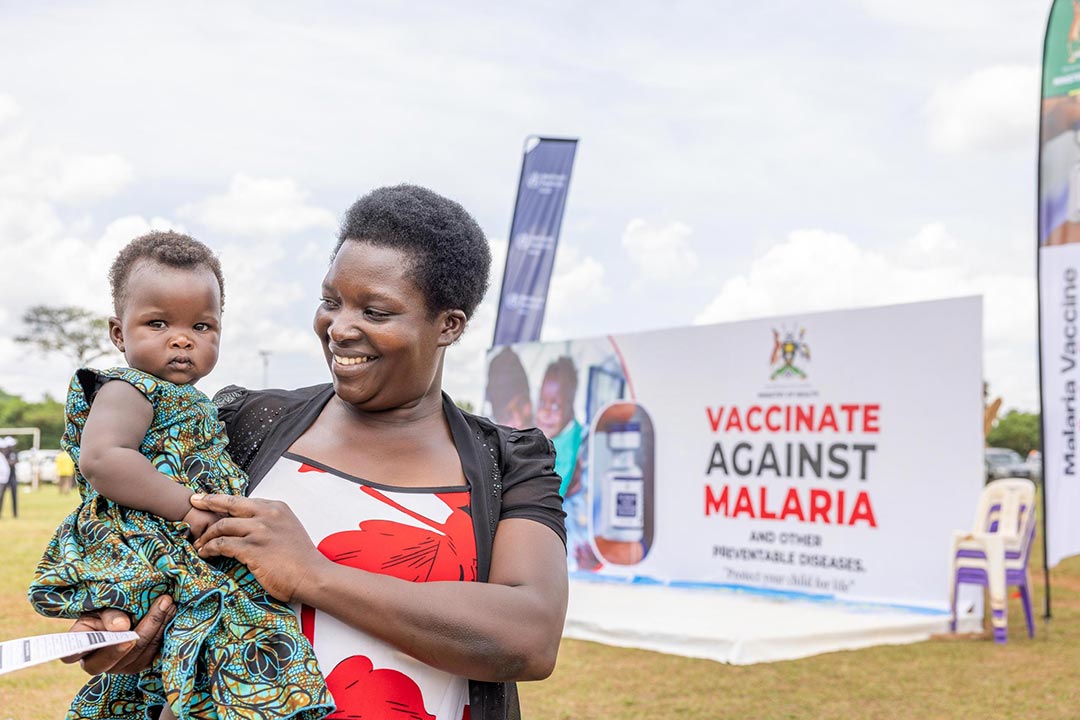
Pilot programs proved the RTS,S vaccine is safe, easy to roll out, and cost-effective—especially in places with limited access to mosquito nets. It worked hand-in-hand with other tools rather than replacing them. In April 2025, Uganda introduced the malaria vaccine into routine immunization, offering it free to children aged 6 to 11 months.
Side effects are generally mild, like fever or slight swelling. Uganda is now using both RTS,S and R21 where available, blending vaccination with other malaria efforts to protect more children and bring us closer to turning the tide on this deadly disease.
Beam of Hope for Uganda
Malaria continues to rob Uganda of its health and productivity. According to the 2024 HMIS report, over 32,900 people fall sick every day, unable to carry out daily activities. Treating just one episode of malaria costs around UGX 15,000—the price of a full meal in many households. Even more heartbreaking, 16 Ugandans die each day from this preventable disease—10 of them are children, out of the 6,500 who get infected daily.
But a new chapter has begun. The malaria vaccine is finally here—and with it, hope. By vaccinating children, Uganda could prevent over 800 severe malaria cases every single day. That’s 800 children spared from hospitalization and potential death—and 800 families spared the distress and cost of treatment.
When used alongside mosquito nets, indoor spraying, and prompt treatment, the vaccine becomes a powerful weapon. It not only protects children but also saves families money, reduces the pressure on hospitals, and boosts national productivity. Over time, it’s expected to save millions of shillings in treatment costs and income lost to illness.
Turning the Tide
The global fight against malaria has reached a pivotal moment, marked by the introduction of effective vaccines like RTS,S and R21. Uganda’s recent integration of the malaria vaccine into its routine immunization program exemplifies this comprehensive approach, aiming to protect children and alleviate the economic strain on families. This multifaceted strategy offers a promising path forward in the quest to eliminate malaria.
Success stories from countries like Mauritius, Algeria, and most recently, Cape Verde, underscore the feasibility of malaria elimination. Mauritius and Algeria were certified malaria-free by the World Health Organization (WHO) in 1973 and 2019, respectively, highlighting the impact of sustained political will, robust health systems, and comprehensive vector control measures. Most recently, in January 2024, Cape Verde achieved malaria-free status, becoming the third African nation to receive this certification. Cape Verde’s success is particularly noteworthy given the challenges posed by its geography and the global COVID-19 pandemic. The country’s approach included integrating malaria elimination into national health policy, enhancing surveillance at points of entry, and fostering multisectoral collaboration. These milestones underscore that, with strategic planning and community engagement, malaria elimination is within reach for other nations as well.
Leave a Reply