

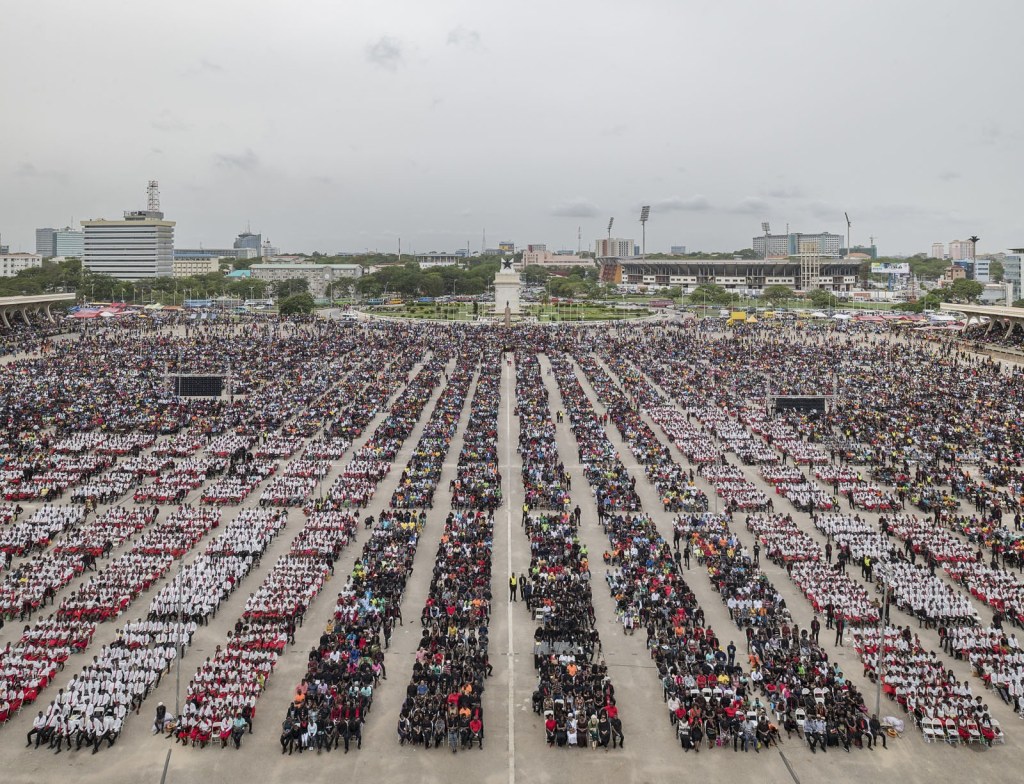
There is something uniquely African about driving past a mega church with LED screens, security guards and a parking lot that looks like a car dealership and then passing a public hospital five minutes later that doesn’t have running water.
If you grew up on the continent, this contrast doesn’t shock you anymore. It’s background noise. Faith is everywhere and so is poverty and somehow they coexist without ever really interrogating each other.
Africa is one of the most religious regions in the world. According to Pew Research, the vast majority of Africans say religion is very important in their lives, with Christianity especially Pentecostal and charismatic movements growing rapidly across sub-Saharan Africa. Faith isn’t just belief here, it’s community, identity, survival and hope.
So when mega churches rise, they don’t rise in a vacuum. They rise in places where the state has failed to provide security, healthcare, jobs or dignity. Churches step in where governments step out. They offer language for suffering. They promise meaning when systems offer neglect.
But somewhere along the way, salvation became expensive.

Mega churches in Africa now operate like corporations. They own universities, private jets, television stations, banks of real estate and international branches. Pastors preach prosperity while living lives that look nothing like their congregations’. This isn’t speculation, it’s documented. Media investigations by outlets like the BBC have examined how some prominent African pastors have accumulated extraordinary wealth, often shielded from scrutiny by religious reverence and weak financial regulation.
The theology behind this accumulation is often framed as “prosperity gospel”, the idea that faith, obedience and giving to the church will result in personal wealth and success. Critics argue that this message shifts responsibility away from structural inequality and places it squarely on individual belief. If you’re poor, you didn’t pray hard enough. If you’re struggling, your faith needs work.
Scholars and analysts have pointed out that prosperity theology thrives most in unequal societies. When economic mobility is limited, hope becomes a commodity. The Research Gate has reported on how prosperity preaching in parts of Africa encourages followers to give beyond their means, sometimes framing sacrifice as a test of faith rather than a red flag.
What makes this harder to talk about is that mega churches also do good. Some build schools, provide food, offer counseling, structure and belonging. For many people, the church is the only institution that feels functional. That complexity is real and it’s why criticism often feels taboo.
But when churches become wealthier than the communities around them, who are they really serving?
Unlike NGOs or public institutions, many churches operate with little to no financial transparency. Donations flow upward, accountability rarely flows back down. In several African countries, religious institutions enjoy tax exemptions and minimal oversight, even as they generate enormous revenue. The lack of regulation around religious finances has been flagged by governance experts as a vulnerability, especially in contexts where public trust is already fragile.
Meanwhile, inequality keeps growing. According to the World Bank , sub-Saharan Africa remains one of the most unequal regions globally, with wealth concentrated among a small elite while millions struggle to meet basic needs. In that environment, the optics of extreme religious wealth become more than uncomfortable. They become political.
Faith, at its core, is supposed to challenge power, not mirror it. Yet mega churches often align closely with political elites, blessing campaigns, hosting leaders and rarely questioning systems that produce suffering. When pastors become power brokers, prophecy starts sounding a lot like public relations.
Still, people keep coming. Because hope is powerful, belief fills gaps policy doesn’t, when life is hard, a promise even a conditional one feels better than silence.
This isn’t an argument against faith. It’s an argument against unchecked accumulation disguised as holiness, confusing spiritual authority with moral immunity, systems where questioning wealth is treated as questioning God.
The real tragedy isn’t that churches are rich.
It’s that in some places, they’re richer than justice, louder than accountability,and more trusted than the state.
And until we learn to separate faith from financial worship, mega churches will continue to grow not just in size but in power while the communities that built them remain exactly where they started.
Leave a Reply