
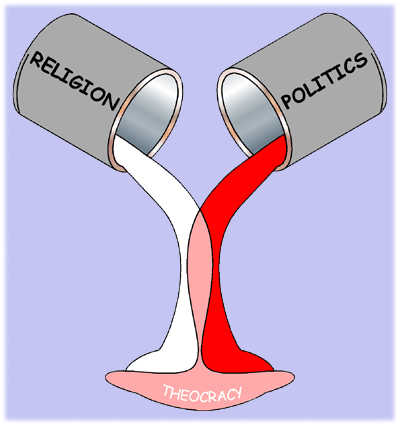
You ever notice how in Africa, religion in politics is like that one cousin who never actually leaves the living room? You tell them it’s time to go but somehow they end up in every conversation, headline and frankly in your business whether you asked for it or not.

Most African constitutions technically call their states secular. I’d like to think that’s fancy wording for “Church and Mosque don’t run the government… supposedly.” But secularism in Africa often feels like a WiFi password everyone claims exists but no one ever actually sees. Religion influences politics so deeply that scholars argue it often defies constitutional boundaries meant to keep faith out of governance, effectively shaping voter identity, leadership credibility and political allegiances across the continent.
Take Nigeria, for example. The constitution guarantees secular governance but many Nigerians will tell you it’s secular in the same way that diet soda is actual soda but you know what’s going on. Religion also affects the legal system. In parts of the North, Sharia law governs personal and criminal matters for Muslims, running parallel to federal law. And then there’s the well debated Muslim-Muslim Ticket that ignited national debate. When both presidential and vice presidential candidates came from the same faith tradition, it forced citizens to reassess whether “neutral state” ever meant anything practical.
This isn’t just a West African quirk. Across the continent, religion plays two roles at once. One beneficial, the other combustible. On the positive side , many faith communities actively encourage civic participation and voter education, pushing young people and underserved communities to engage in democratic processes. In places where mistrust of government runs high, churches and mosques sometimes serve as trusted intermediaries that mobilize voters and advocate for accountability. That’s actually something to celebrate as long as religious actors stop short of openly endorsing specific candidates from the pulpit.
On the other side, sometimes the intersection of religion and politics in Africa feels less like respectful coexistence and more like a supernatural reality show without a script. In Uganda and other parts of East Africa, politicians and voters alike occasionally attribute political fortunes to spiritual forces. In some rural rallies for example, people blame bad campaign momentum not on weak policy but on bad juju or curses.
It gets weirder. In Zambia, two men were convicted and imprisoned for allegedly trying to use witchcraft to kill the president, complete with charms and in reports, a live chameleon. This was an actual criminal proceeding under laws dating back to colonial times. Witchcraft here becomes a legal and political issue.
Across West, East and Southern Africa , leaders also attempt symbolic spiritual gestures like building chapels on state compounds or publicly invoking prayer in parliamentary sessions often to blur the line between personal faith and public duty. In deeply religious societies, claiming divine favor even implicitly becomes a political strategy.
When religion becomes the primary lens through which people evaluate leadership, policy debates are replaced with spiritual endorsements or spiritual fear tactics then democratic discourse weakens. Instead of discussing unemployment, education, healthcare or infrastructure, elections can shift toward whose god is bigger, whose prayer is louder, whose spiritual protection is stronger.
But to frame religion as purely negative in politics would be unfair and inaccurate. Many religious organizations in Africa have been positive civic actors, educating communities about rights, encouraging youth participation and serving as watchdogs against corruption. They have helped communities that feel alienated from formal political systems find a voice. The trick is ensuring that religious involvement empowers citizens rather than opt for the state.
So what’s the bottom line? Africa isn’t going to become secular in some textbook sense where religion has zero influence because that horse left the barn long ago. Instead, what’s emerging is a negotiation on how to balance deeply held spiritual values with constitutional neutrality, ensuring freedom of religion without letting religion override democratic processes. In other words, Africa might need to rethink what secularism means within a context where faith is part of everyday life.
If religion in African politics were a character in a TV show, it would be the one with mysterious powers, sometimes helpful, sometimes terrifying and always influential. You can’t just remove it from the plot, you just have to understand how it shapes every twist and turn. And if we want democracy to thrive, we have to learn to listen without being blind to manipulation and respect faith without letting it write the politics script.
That’s the real challenge and honestly, the most interesting one.
Leave a Reply